You want to line a walkway, patio, or garden bed with nighttime lighting that needs no electricity or installation fuss. Solar pathway lights do all that work, but not every model fits every yard. Yards with a nearby outlet can also suit outdoor landscape lighting, which runs steadily through the whole night.
If you want the brightest output and adjustable modes, choose a model that lists brightness in lumens. For longer runtimes on short days, pick one with a larger battery or higher panel conversion rate. If your winters are long and dark, a light rated for 10+ hour runtime matters more than one promising 24 hours of charging in full sun.
What Matters When Choosing Solar Pathway Lights
These five models all turn on at dusk and off at dawn, install with ground stakes, and resist rain and snow. They differ most in how bright they shine, how long they stay lit, and how much power their panels capture from sunlight.
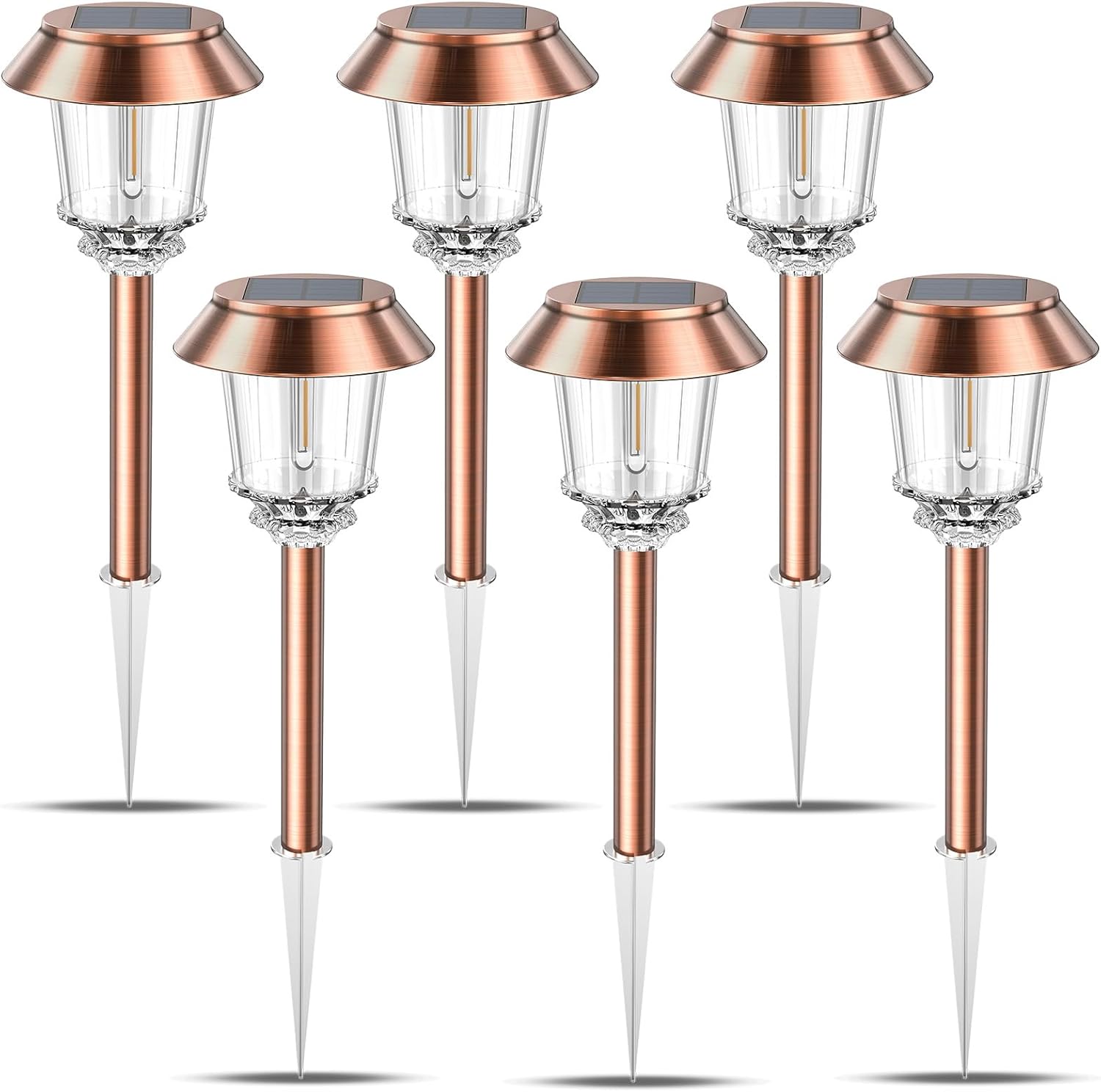
XMCOSY+ Solar Pathway Lights Outdoor, 6 Pack Solar Light Outdoor Waterproof

XMCOSY+ Solar Lights Outdoor 6 PCS, 10/25 LM 2 Lighting Modes Garden Lights

Mancra Solar Pathway Lights, 8 Pack LED Solar Lights Outdoor Waterproof, Glass Metal Garde...

Amzarp 8 Pack Solar Garden Lights, Outdoor Bright LED Solar Pathway Lights

BITPOTT Solar Lights Outdoor, 8 Pack Pathway Lights, Warm White, IP65
Which Solar Pathway Light Fits Your Yard
Your choice depends on how bright you need your path, how much sun your yard gets during the day, and how many nights your region has without full daylight. Your seating area may call for low-voltage landscaping lights if it sits in heavy shade near an outdoor outlet.
- Brightness in lumens tells you how much light each fixture produces.
- Battery size and solar conversion rate predict how long lights stay on after darker days.
- Runtime promises show what the manufacturer expects under good conditions; actual performance varies with weather and sun exposure.
- Pack counts range from 6 to 8 lights, which affects how far apart you can space them.
Summer Yards or Plenty of Sunlight
The XMcosy Diamond Pathway suits yards that get good sun and want customizable brightness. Its 40-lumen high mode is the brightest in this group, and you can drop to 10 lumens for softer ambient light. Choose the XMcosy Warm White instead if you prefer a larger battery (1000 mAh) that may stretch runtime even when days are shorter, though its 25-lumen max is dimmer.
Longer Nights or Limited Charging Time
The BITPOTT Pathway Lights promise 11 to 24 hours of runtime, the longest among these five. This matters in fall and winter when daylight hours shrink. Both XMcosy models are rated for 8 to 12 hours, and Mancra and Amzarp promise dusk-to-dawn coverage if you charge them in full sun. Choose BITPOTT if your yard sits partly shaded or your winter days are very short.
Larger Gardens or Long Pathways
Mancra, Amzarp, and BITPOTT each ship eight lights per pack, while both XMcosy models include only six. Eight lights let you space them closer or cover a longer path. All three eight-packs use glass or high-transparency lampshades, and all feature warm white light (3000K where stated) to blend with garden aesthetics.
Exact Brightness Control
Only the two XMcosy models list brightness in lumens: 10 or 25 for the Warm White, and 10 or 40 for the Diamond Pathway. Mancra, Amzarp, and BITPOTT describe their light as warm white and bright enough for pathways but do not specify lumen output. Choose an XMcosy model if you want to know exactly how bright each setting is.
Our Picks
These three models stand out for different reasons: one for maximum brightness and customizable output, one for battery capacity and longer potential runtime, and one for the longest rated runtime and eight-light pack size. These differences matter most when homeowners are weighing low voltage pathway lights for yards that need safe lighting without new wiring.
Highest Brightness: XMCOSY+ Solar Pathway Lights Outdoor: The XMcosy Diamond Pathway reaches 40 lumens on high mode, brighter than any other model in this group. Choose it if you want adjustable 10- or 40-lumen settings for winter and summer, and if your yard gets adequate daily sun to charge its 600 mAh battery in 6 to 10 hours. Switch to the XMcosy Warm White if you prefer a larger 1000 mAh battery over peak brightness.
Largest Battery: XMCOSY+ Solar Lights Outdoor 6 PCS: The XMcosy Warm White holds a 1000 mAh battery, larger than the XMcosy Diamond (600 mAh) and Mancra (800 mAh). On low mode (10 lumens), it promises up to 10 hours of light on a full charge. Pick this if you live where winter days are short and you want the best chance of the lights lasting all night, though its 25-lumen max is dimmer than the Diamond model.
Longest Runtime Promise: Mancra Solar Pathway Lights: The BITPOTT Pathway Lights claim 11 to 24 hours of runtime depending on how much sun they capture. This beats the 8- to 12-hour ratings on XMcosy models and the dusk-to-dawn claims on Mancra and Amzarp. Choose BITPOTT if your yard sits partly shaded, or if you live where autumn and winter nights stretch well beyond 12 hours and you need the lights to last until dawn.
Questions About Solar Pathway Lights
How long do solar pathway lights take to charge?
Charging time ranges from 4 to 10 hours depending on the model and your sunlight. XMcosy Diamond Pathway models need 6 to 10 hours of full sun; XMcosy Warm White, 4 to 6 hours; Mancra, 6 to 8 hours; and Amzarp, 4 to 8 hours. BITPOTT recommends charging in full sunlight with panels kept clear. Actual charging varies with weather, cloud cover, and panel orientation.
Do these lights work on cloudy days?
Yes, but runtimes will be shorter. Solar panels still capture diffuse light on cloudy days, but the conversion rate drops. Battery capacity and panel efficiency matter most on overcast stretches. Larger batteries like the XMcosy Warm White (1000 mAh) and higher conversion rates (XMcosy Diamond at 25-30%) help extend light output even when days are dim or short.
Can I adjust the brightness of solar pathway lights?
Only the two XMcosy models offer adjustable brightness modes. The Diamond Pathway offers 10 LM (low) or 40 LM (high); the Warm White offers 10 LM or 25 LM. Low mode is marketed for winter and lasts up to 10 hours; high mode is for summer and lasts 5 to 8 hours. Mancra, Amzarp, and BITPOTT do not list switchable brightness modes.
Are solar pathway lights waterproof enough for snow and freezing?
All five models carry IP65 waterproof ratings and materials rated for extreme weather including rain, snow, frost, and sleet. XMcosy and XMcosy use stainless steel and aluminum; Mancra and Amzarp use ABS shells with stainless steel poles; BITPOTT uses similar durable housings. Waterproof housing does not prevent battery performance loss in extreme cold, but the lights will not leak.
How many lights do I need for a pathway or garden bed?
Most manufacturers recommend spacing lights 2 to 3 feet apart along a path. XMcosy models ship six lights per pack; Mancra, Amzarp, and BITPOTT each ship eight. For a 15-foot pathway, six lights spaced 2 to 3 feet apart cover it; for longer runs or wider coverage, the eight-light packs offer more flexibility and denser spacing if desired. For a larger yard with trees and facades, some owners pair these with landscape lighting systems for uplighting.