Portable generators pump out power wherever you need it, but running them too close to people and buildings creates exhaust hazards. Best Extension Cords For Portable Generators let you distance the generator from your workspace or home while delivering full power safely. Heavier gauge runs of outdoor extension cords help keep voltage steady over longer distances.
If you’re plugging into a standard household panel, the Champion model converts 30-amp generator power to three regular outlets. If you’re hardwiring to a manual transfer switch, the PlugSaf cords maintain the full 30-amp circuit with a single industrial connector.
What to Compare
All three cords handle 30 amps and 10-gauge copper wire that stays flexible in cold and heat. The key differences are cord length, outlet count, and voltage rating. Your choice depends on distance from the generator and how you plan to connect it.

Champion Power Equipment 25-Foot 30-Amp 125-Volt Fan-Style Generator Extension Cord (L5-30...

50FT 30 Amp Generator Cord 4 Prong, 10AWG 125/250V 3750/7500W STW
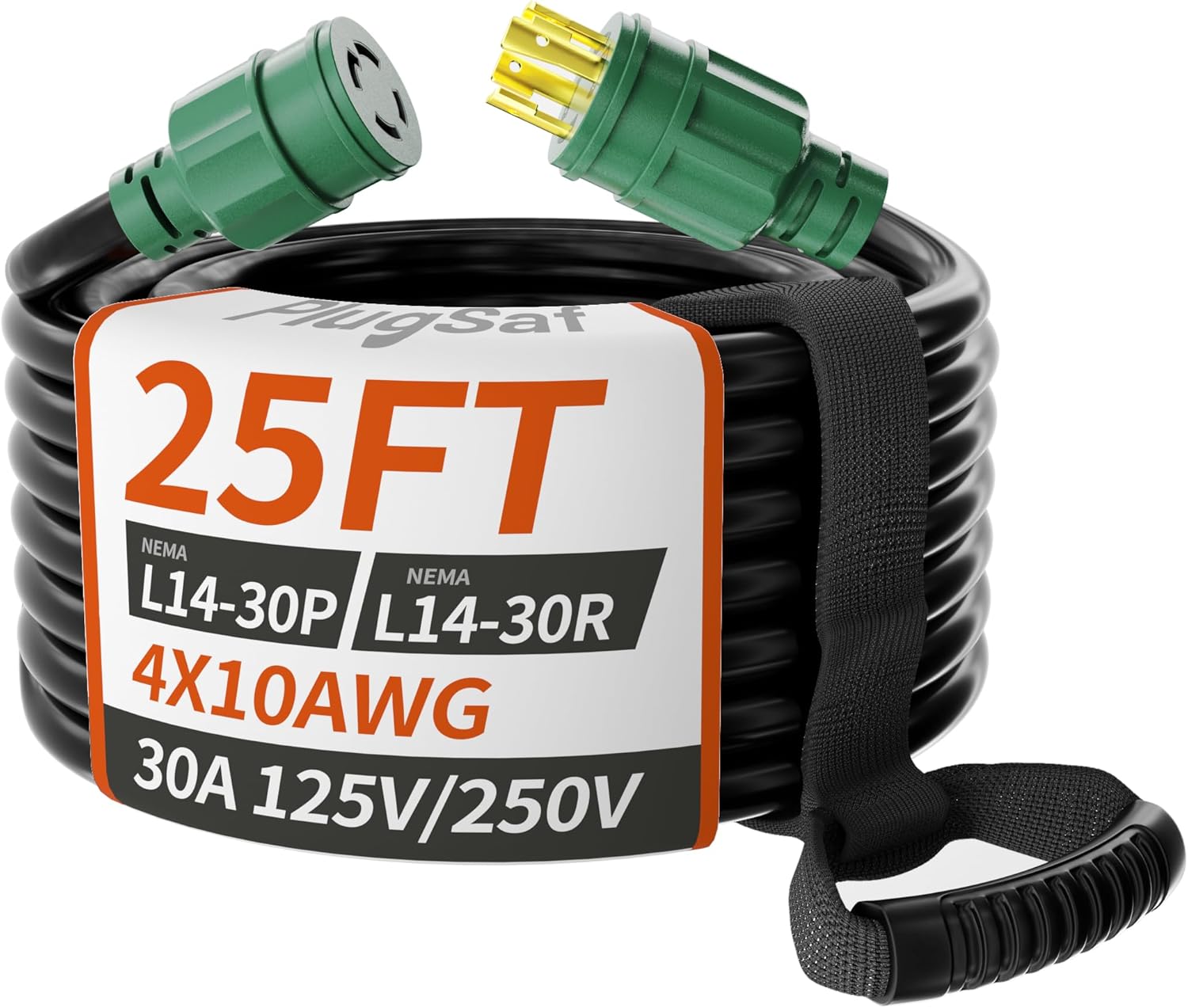
25FT 30 Amp Generator Cord 4 Prong, 10AWG 125/250V 3750/7500W STW

50FT L14-30P/L14-30R 30 Amp Generator Extension Cord, ETL Listed

35FT 30 Amp Generator Extension Cord L14-30P/L14-30R, STW ETL Listed
Who Should Buy Which Cord
Your setup determines which cord works best. Think about how far your generator will sit from where you use the power, and whether you’re connecting to existing outlets or a transfer switch.
- Cord length: Does 25 feet reach far enough, or do you need to stretch 50 feet?
- Connection type: Are you plugging into household outlets or a hardwired transfer switch?
- Voltage needs: Standard household use is 125 volts; transfer switches usually handle 125/250 volts.
- Weather protection: All three cords resist rain, sun, and freezing temperatures down to negative 40 degrees Celsius.
Running Multiple Household Appliances
The Champion 25-Foot cord is designed for this job. It converts the generator’s 30-amp output into three standard 15-amp outlets, letting you plug in several devices at once. If you only need one connection point or prefer to hardwire your setup, the PlugSaf models offer higher voltage capability instead.
Long-Distance Emergency Backup
The PlugSaf 50-Foot 4-Prong reaches generators sitting 50 feet away, the longest distance among these options. If your emergency setup spaces the generator farther from your RV or home, this length closes the gap. The Champion and PlugSaf 25-Foot models require the generator within 25 feet.
Hardwired Transfer Switch Installation
The PlugSaf cords use industrial L14-30 connectors that twist-lock into a manual transfer switch, designed for permanent or frequent hookups. The Champion fan-style cord uses household outlets instead, making it simpler to connect but less suited for transfer-switch systems. Choose PlugSaf if your setup includes a transfer switch; choose Champion for direct outlet connections.
Our Picks
All three cords meet strict safety standards and include weather-resistant insulation rated for outdoor use in rain, sun, and freezing cold. Here’s which one fits your situation. Some homeowners also need outdoor light fixtures for porches and patios, where wiring must suit damp conditions.
Multiple Outlets: Champion Power Equipment 25-Foot 30-Amp 125-Volt Fan-Style: The Champion 25-Foot cord converts a 30-amp generator connector into three standard household outlets, letting you plug in multiple devices without adapters. Choose one of the PlugSaf models if you need a transfer-switch connection instead.
Maximum Distance: 50FT 30 Amp Generator Cord 4 Prong: The PlugSaf 50-Foot 4-Prong reaches the farthest from your generator, stretching 50 feet while maintaining the full 30-amp circuit for a hardwired transfer switch. Choose a 25-foot model if your generator sits closer to the connection point.
Compact Length: 25FT 30 Amp Generator Cord 4 Prong: The PlugSaf 25-Foot 4-Prong delivers all the same features as its 50-foot sibling, including 10-gauge copper wire and 7,500-watt capacity, in a shorter, easier-to-store package. Pick this if your setup needs 25 feet of reach and prefers compact storage.
Questions About Generator Extension Cords
What does 30 amps and 10 gauge mean?
Thirty amps is the maximum electrical current the cord handles safely; 10-gauge describes the copper wire thickness. Thicker wire (lower gauge numbers) resists overheating during long runs. All three cords use 10-gauge wire, so they all handle 30 amps equally well.
What’s the difference between 125V and 125/250V?
One hundred twenty-five volts is standard household power. Two hundred fifty volts is what hardwired transfer switches and RV pedestals often use. The PlugSaf cords support both, while the Champion supports 125 volts only. Check your transfer switch or RV connection before buying.
Why do these cords have outdoor ratings like IP65?
IP65 means the cord resists water spray and dust, so it won’t short out when exposed to rain or spray from a garden hose. All three cords carry this rating, plus flame-resistant insulation and temperature ratings from negative 40 to over 100 degrees Celsius for year-round outdoor use. Many owners also power weatherproof outdoor light fixtures from the same generator on patios and walkways.
Will the cord stay flexible when it’s cold outside?
Yes. The Champion specifies cold and heat-resistant insulation, while the PlugSaf models rate to negative 40 degrees Celsius. At freezing temperatures, outdoor cords can become stiff and crack. These three maintain flexibility in extreme cold, reducing that risk.
Do any of these come with storage help?
Both PlugSaf models include an adjustable cord organizer for neat coiling and hanging, making transportation easier and preventing tangles. The Champion includes dust covers to keep the outlets clean. Consider ease of storage if you move your generator often.